I agree with the article because it discusses an altered form of the American Dream to what it was when America first started out, while still denying that it is dead. Back then the American Dream was mainly focused on prosperity and success, but it has changed to deal more with equality, which is ironic considering how people back then were much less equal than they are today. Martin Luther King Jr. himself highlights this very issue, of inequality in his "I Have A Dream" Speech. King, in his speech discusses a divided America and shares his dream for an America in which people of colors, races, ethnicities, nationalities, and religions could live in unity. That was his American Dream, and it seems many people today have taken inspiration from such figures as King, to fit their personal views of today's society. For instance, feminists are fighting for equal pay for women and other social biases/differences held agianst them from men. Such people may also have taken inspiration from Stanton and argue that women aren't equal. Other people argue that the racial divide in this country that has been here for centuries, although it has narrowed, is still present and need to be addressed immediately. Black Lives Matter (BLM) for instance, riots and argues whenever an African American individual is shot or killed by police unjustly. These people argue that African Americans are not socially equal. On top of racial inequality and gender inequality, there also exists sexual inequality. There are members of the LGBT community (Lesbian, Gay, Bisexual, Transgender) who are not socially equal or are not as accepted socially as much as a straight person. All of these are groups and communities that will not rest until THEIR American Dream has been reached. Equity. So yeah, the American Dream has changed, but it is certainly still exists, and people are certainly still fighting for it.

Bill O'Reilly, the columnist whose columns, I analyzed in the first quarter, uses two specific rhetorical devices very frequently, I've noticed. Bill O'Reilly uses rhetorical questions and juxtaposition in order to strengthen his argument and get his purpose across to his audience throughout his various columns. Through his use of rhetorical questions, he mainly focuses on trying to get the audience to share either his view point or the view point of whatever or whomever he is discussing. Using this tactic allows him to give his argument in a way that's easier for the audience to digest, now that they've been subjected to O'Reilly's rhetoric and can see where he is coming from. On the other hand, O'Reilly's use of juxtaposition allows him to, oppose to getting the audience to relate to the topic in rhetorical questions, compare two subjects rather than audience and subject. This comparison and contrast of two subjects allows O'Reilly to give the audience a broader perspective and a better understanding of how two subjects relate to each other in terms of the main topic.

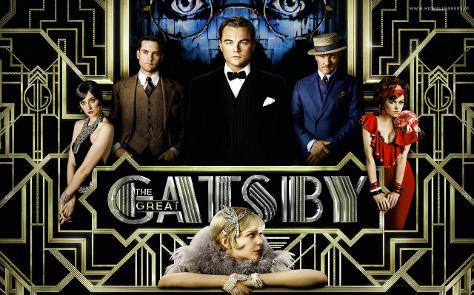
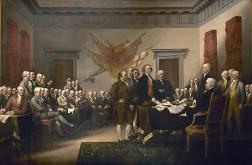
In "The Great Gatsby", Gatsby lives a life of wealth. But regardless of all his popularity and wealth he is dissatisfied, because his American Dream cannot be achieved without Daisy. In this situation, the American Dream cannot be achieved due to lack of completeness and the one thing that means more than anything to him. In Stanton's declaration however, women as a whole are dissatisfied for a different reason. Equity. Women, even after the separation of the colonies and GB, we're not equal, and because of this they were dissatisfied with the fact that their rights were not on par with that of men. They could not achieve the American Dream so long as they were not equal. Lastly, in Jefferson's Declaration, he describes a necessary change; the separation of the colonies and GB. But even with their freedom, Jefferson, and all of America for that matter, was simply dissatisfied with just the separation. The Declaration of Independence also called for Life, Liberty, and The Pursuit of Happiness, among other things that Americans could not live without if they were to live the "American Dream".
I personally do not agree with the statement that all Americans are always dissatisfied and can never truly reach the American Dream with their thirst for more. Although it may be true for some, others are content even with a life lacking wealth. For many people a life with friends, family, and relationships, is even if there is a lack of wealth. For others it's the other way around. It is this ever changing variable of how the American Dream is perceived that knowing what would make anyone achieve their American Dream would be impossible, at first glance. In order to satisfy such people, what they wish to have and possess in life is their American Dream and nobody else's.

Next quarter, in order to ensure that I do better on my formal paper, I will dedicated more time to said paper. I admittedly, did not spend as much time writing this one as I wouldve liked. This means that I will, before writing my paper, outline the format in which I write the paper, and make sure I write and revise a rough draft prior to submitting a final product.
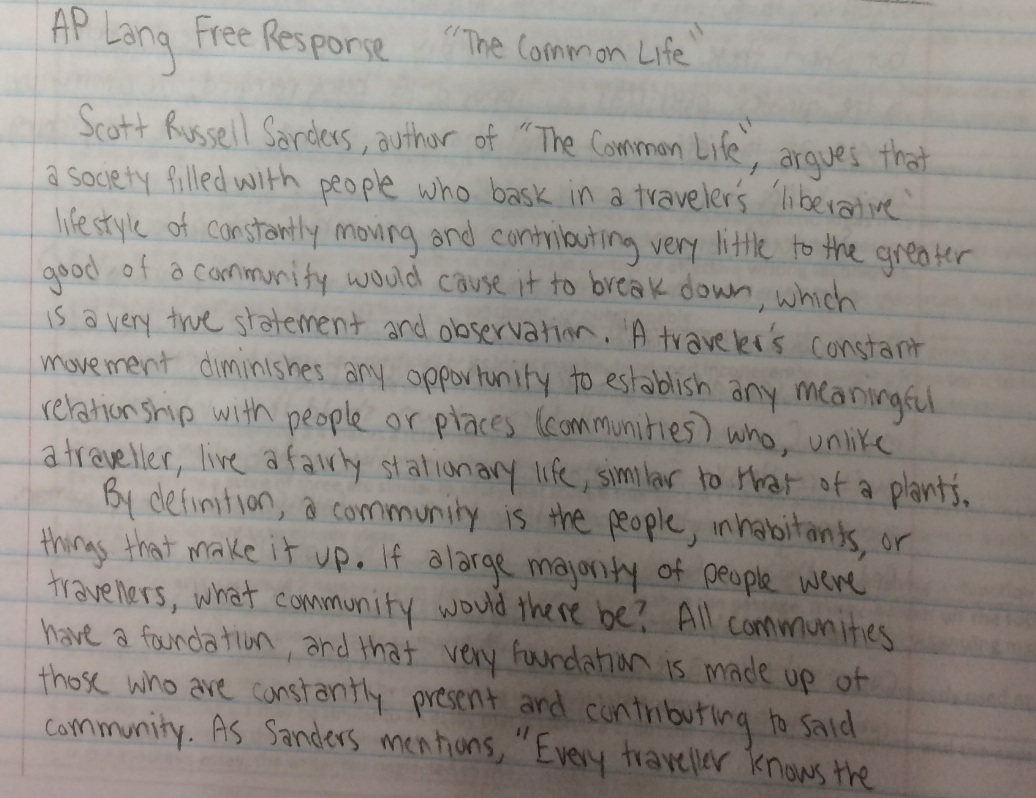
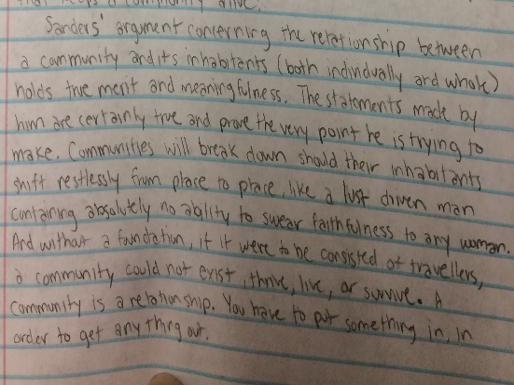
I really enjoyed writing the argumentative essay on "The Common Life" because it put me in a position, where I, as the writer, could choose what stance I took. Not to mention, the essay was concerened with the matter of social structure which, in my honest opinion, was more interesting, than consumer/industry relationships (Kennedy), or the restructure of a failing (and appearantly staple part of the US.) mailing company.
In quarter 1, I learned how to properly write an analysis essay and apply that knowledge into my own formal paper. In addition, I learned about political issue and how politicians/columnists use it, and I also learned about the American Dream and how its true definition differs from person to person. The most meaningful assignment was surely the formal paper because it was the first time I had ever written a paper with a page/word minimum, and it, as a matter of fact, was the first 'formal paper' I'd ever written, not to mention I got a very good score on it. I honesty wish we had skipped the sub work warm ups that took like 45 minutes to complete because I felt like they were unnecessary and very time consuming to the point where I couldn't finish my actual work. I gained the most from our dissection of the 5 paragraph essay monster because I was so used to always writing in that format that picking it apart, helped me understand how to avoid writing in that manner, if need be. I am most looking forward to learning how to do proper research and incorporate external sources into my writing, which also my goal. I want to learn how to properly compose an essay like that so that when I go to college I can carry that knowledge and excel in my writing. Overall quarter 1 has been a great experience in AP Lang, hence the pic of Trump with his thumbs up.

In Their Eyes Were Watching God (TEWWG) Hurston tells a tale of a woman named Janie, which entails themes of both race and culture. Throughout TEWWG, she uses the way the characters speak as a way to advance her theme of race. While this technique may not be a rhetorical or literary one, it is just as powerful in developing a theme and creating a backbone for it.
For the most part, the characters who spoke in the manner mentioned above, were African American. The southern-like accents used throughout the novel for these characters - in my eyes - gave them more of a primitive and unintelligent feel. When compared to the way white Americans speak, it sets a very distinct separation between the cultures of both. This adds to the theme that race puts you at a socially separate place than those of other races, particularly white.
In addition, the use of such seemingly unintelligent language, is contradicted, particularly in Janie's case, through the fact that Janie is wise for the most part. This also relates to her gender. Although she is a woman, she defies the social norms of gender stereotypes. Her hair - and wiseness contradicted by her accent and form of speaking - shows that she is not like the others, but instead sets herself apart from the crowd. Society puts stereotypes and niches, according to race, gender, etc., but as Janie demonstrates, those can be defied.


This quarter I learned that I need to be more serious about my grade. Although I had pretty much all my assignments completed, not doing my Precis almost ruined my quarter 2 grade. In additon, I also learned how to properly create a paper using the MLA format and incorporating sources into my paper, through arguments, counterarguments, and rebuttals. The most meaningful assignment was the paper itself, because it allowed me to get a feel for how colleges expect papers to be written, including citing the sources.
I wish we had skipped the Precis paper, only because I didn't do them and because I could not find the motivation to do them. I felt like it was not as important as what we learning in class. In quarter three I'm looking forward to expressing my beliefs/views on ethics. For third quarter I once again, hope to get an A in this class, and plunge into the heated topic that is ethics.